The Fascinating History
of Japanese Martial Arts!
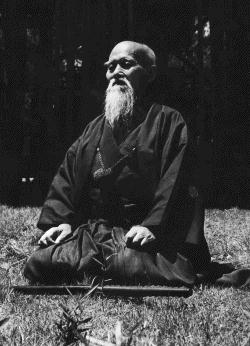
Morihei Ueshiba O'Sensei - Aikido Founder
Japanese Martial Arts includes a massive variety of martial arts that are native to Japan. At least three Japanese terms are often used... budo (martial way), bujutsu (art of war), and bugei (martial art).
The term budo usually indicates the practice of martial arts as a way of life, and includes physical, spiritual, and moral dimensions with a focus on self-improvement, fulfillment, and personal growth. Bujutsu relates particularly to the practical application of strategy and techniques in actual combat situations.
Bugei refers to refinement of tactics, strategy, and techniques to develop a system of instruction within a formal learning environment.
The origin of Japanese martial arts is from the warrior traditions of the samurai and the restricted use of weapons by the non-warrior classes.
Originally, samurai were skilled in weapons, unarmed combat, and attained mastery of combat skills, to achieve glory for themselves or their master. Over time, it became a philosophy of spiritual goals through perfect skills.
The teaching and training of Japanese martial arts evolved from battlefield conditions, then through a period of peace, and into modern times. Many arts moved towards more peaceful practices and taught budo.
There were vast differences in training tools, methods, and philosophy across schools and styles. But Japanese martial arts can generally be divided into koryu (traditional/old schools) and gendai budo (modern).
Sumo is often thought to be Japan's national sport. The earliest written records of Japan, dated from the 8th century A.D., record a sumo match in 23 B.C., and continued until one man was too wounded to continue.
From 728 A.D. a tradition started of having matches in the presence of the emperor, spread to Shinto festivals, and eventually included in military training. By the 17th century, sumo was a professional sport, open to the public, and enjoyed by the upper classes and commoners.
Grand tournaments are held every year in Japan, and each professional fighter's name and relative ranking is published in an official list, called the banzuke, which is enthusiastically followed by sumo fans.
Jujutsu is the art of using indirect force, such as joint locks or throwing techniques, to defeat an opponent. Methods include kicking, punching, body throws, joint-lock throws, unbalancing, pinning, strangling, grappling, etc.
Defenses include blocking, evading, off balancing, blending, and escaping.
Minor weapons such as the tanto (dagger), ryufundo kusari (weighted chain), jutte (helmet smasher), and kakushi buki (secret or disguised weapons) were usually included in koryu jujutsu.
They later developed into systems designed to deal with opponents without armor and not on a battlefield. For this reason, they include extensive use of atemi (vital point-strikes), valuable for street fights.
Today, jujutsu is practiced in both ancient and modern forms that have also been included in judo, aikido, karate, wrestling, mixed martial arts.
Swordmanship became the most important aspect of the Japanese martial arts, after horse-riding and arrow shooting. The main development of the sword occurred between 987 A.D. and 1597 A.D.
During peaceful times, warriors trained and invented new techniques that were tested during war, and passed on. In 1600 A.D., Tokugawa Ieyasu gained control of Japan, and a period of peace lasted until the Meiji Restoration.
The sword techniques changed from an art for killing, to include philosophy, personal development and spiritual perfection.
Kenjutsu (art/science of sword) involves the sword training of two partners with swords drawn, practicing combat drills. Historically it was practiced with wooden katana (bokken), and included rehersed forms, called kata, or sometimes called kumitachi, and similar to the partner drills practiced in kendo.
Advanced students also include freestyle practice.
Iaijutsu (art/science of mental presence and immediate reaction), is the art of drawing the sword that is technically complex, with a focus on perfect form. The main aspects are smooth, controlled movements of drawing, striking, cutting an opponent, removing blood from blade, and replacing the sword in the scabbard.
Iaido is the modernization of iaijutsu, but in practice is often identical. The replacement of jutsu with do is part of the 20th century focus on personal and spiritual development, as in other Japanese martial arts.
Naginatajutsu is the Japanese art of wielding the naginata. Most practice is in a modern form called naginata-do, and competitions are held. During the late Edo period, it was used to train women, and most styles are headed by women.
Sojutsu is a Japanese martial arts of fighting with the spear (yari). For most of Japan's history, sojutsu was practiced extensively by traditional schools. In times of war, it was a primary skill of many soldiers.
Ninjutsu was developed as a collection of survival techniques in the warring state of feudal Japan in the 14th century. The ninja used their art to survive in a time of violent political turmoil.
It included methods of gathering information and techniques of avoidance, and misdirection. Ninjutsu can also involve training in disguise, escape, concealment, archery, medicine, explosives, and poisons, etc.
Original Japanese martial arts were almost entirely sogo (comprehensive) bujutsu. With the long peace of the Tokugawa shogunate there was an increase in specialization with many schools identifying with major battlefield weapons.
Gendai Budo (modern martial way), is a general term to describe Japanese martial arts that are more modern. Either the art was founded after 1868, or it changed its methodology and lost its koryu status.
Judo (gentle way), is a modern grappling-based martial art, usually practiced as a sport. It was created by Jigoro Kano (1860–1938) who was a brilliant martial artist who took the koryu arts of Kito-ryu and Tenjin Shin'yo-ryu jujutsu, and focused on freestyle practice and competition.
Kano developed a system of techniques and training, which became an Olympic sport in 1964, and spread throughout the world. The 'Kodokan', has students worldwide, with other schools founded by Kano's students.
Kendo (way of sword), is based on Japanese arts and sword fighting descended from several schools including Itto-ryu. The modern form of kendo took shape with the introduction of shinai (bamboo), and lightweight wooden armour. This allowed the practice of strikes at full speed and power without risk of injury.
Most practice of modern kendo is governed by the All Japan Kendo Federation, founded in 1951. Competitions are judged by points, with the first competitor to score two points on their opponent declared winner. Practitioners also compete in forms (kata) competitions, using wooden or blunted metal swords.
Aikido (way of harmony) is a modern grappling-based Japanese martial art developed by Morihei Ueshiba (1883–1969). It consists of striking, throwing and joint locking techniques and is known for its blending with an attacker, rather than meeting force with force.
It focuses on joining the intent of an opponent in order to find opening to take control. Also involves the spiritual and philosophical development of students.
Morihei developed Aikido from his combat studies of Daito-ryu Aikijujutsu with Sokaku Takeda, and spiritual studies with Onisaburi Deguchi of the Omoto Kyo.
Aikido Success Blueprint offers you Key Action Steps to quickly improve your ability to develop aikido skills. A unique gold-mine of knowledge!
More Japanese
Martial Arts...
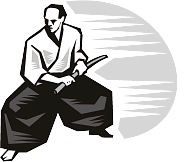
Kyudo (way of the bow), a modern name for Japanese archery. Originally in Japan, kyujutsu was a discipline of the samurai, the Japanese warrior class.
From the 16th century, firearms gradually replaced the bow as the most dominant battlefield weapon. As the bow lost its significance as a weapon of war, and under the influence of Buddhism, Shinto, Daoism and Confucianism, Japanese archery became kyudo.
In some schools kyudo is practiced as a refined contemplative practice, while in other schools it is practiced as a modern day sport.
Karate (empty hand) is a mix of Okinawan arts called 'te', and Chinese martial arts. Gichin Funakoshi (1868–1957) regarded as the father of modern karate, founded Shotokan karate, gave demonstrations in Tokyo in 1917, and karate was included in Japan's public school system.
The white uniforms and the kyu/dan ranking system were then adopted.
Karate practice is mainly characterized by straight punching and kicking techniques executed from a stable, fixed posture. Many styles of karate incorporate the forms (kata) developed by Funakoshi and his teachers, and practitioners also take part in full, light, and no-contact competitions.
The principle of aiki is a joining of energy, or harmonizing physically and mentally with an opponent to avoid direct conflict. In practice, aiki is achieved by joining with the physical motion and the mental intent to redirect the energy and the will to calm down a situation.
Aikido is founded on the principle that controlling an opponent can be achieved by aiki to defeat them without causing serious harm.
Budo (way of war) relates particularly with Japanese martial arts styles.
Bushido (way of the warrior) is a code of honor for the samurai way of life. It emphasizes courage, bravery, and loyalty to their lord (daimyo).
Courtesy, etiquette, politeness, humble, gentle, boldness, formal bow, etc. Everything begins with rei and ends with rei, in training and daily life.
Hard and Soft (in/yo or yin/yang).
The hard is a direct attack, or defense with a block or parry. Hard techniques are usually in straight lines. The soft is an indirect use of force, which avoids or redirects opposing force. Avoiding an attack, followed by extra force to unbalance an attacker, in circular motion.
Openings are the foundation of a successful attack, physical or broken concentration. In combat between masters, each would stand almost entirely motionless until the slightest opening was spotted. One would launch a devastating attack to finish it with a single blow.
Initiative is taking advantage of an opening with total commitment and ignoring a possible counter-attack. Or an active attempt to encourage an attack by the opponent that will create a weakness in their defense, often by faking an opening that is too enticing for the opponent to ignore.
Sensei is the title used for a teacher, similar to a college 'Professor'.
There are two main systems of education in the Japanese martial arts. Before 1868 it was based on a syllabus to preserved tradition. It was organized by a series of levels passed down within the Ryu (tradition).
Resulting in the student achieving a license of total transmission (menkyo kaiden), permitting the student to teach outside of the ryu.
The modern system after 1868, awards belts in accordance with students reaching a particular level. Students progress by promotion through formal testing through a series of grades (kyu), followed by a series of degrees (dan).
Some arts use only white and black belts to distinguish between skill levels, while others use a progression of colored belts.
Kata (forms) are the backbone of martial arts, but different schools and styles put a varying amount of emphasis on their practice.
Aikido Success Blueprint offers you Key Action Steps to quickly improve your ability to develop aikido skills. A unique gold-mine of knowledge!
For more information Click Here
Harmony of Mind-Body-Spirit
FREE Monthly Newsletter
Ancient Secrets, Master Strategies and Key Action Steps
Plus Free eBook on Health and Well-Being... Sign Up Now!

Has this page been useful to YOU? It may benefit other people too! Please go ahead and pass it on - Share via the Link Bar below - many thanks!
Sick of the Elite Control System? Unplug from the Matrix Now!






Recent Articles


-
Learn How to Unplug From The Matrix
Apr 19, 24 08:13 AM
 Want to unplug from the matrix? Fed up with government and media, lies? Finally some answers. This info is mind blowing!
 -
Mantras and Chants - Sound Vibration Power!
Apr 19, 24 08:12 AM
 Revealing Info on mantras and chants, kotodama, sound healing, Optimum Health Secrets for glowing health. Plus FREE Harmony Newsletter, and so much more!
 -
Kotodama Sound Vibrations
Apr 19, 24 08:11 AM
 Revealing Info on kotodama, sound vibrations, mantras and chants, yoga, chakras, zen, Optimum Health Secrets, FREE gifts, harmony ezine, and so much more!